OEM drip irrigation manufacturing allows agricultural equipment distributors, irrigation brands, and project suppliers to source products according to their own market requirements. However, choosing an OEM manufacturer involves more than comparing prices. Buyers should evaluate product specifications, emitter performance, material quality, filtration compatibility, customization requirements, and manufacturing quality control before placing bulk orders.
For buyers sourcing drip tape, dripline, pressure-compensating drippers, filters, and irrigation fittings, the most reliable approach is to define the application requirements first and then verify whether the manufacturer's products and production processes can meet them. A well-planned OEM project helps reduce compatibility issues, maintain consistent product quality, and improve long-term supply reliability.
What Does OEM Drip Irrigation Manufacturing Involve?
OEM drip irrigation manufacturing refers to producing irrigation equipment according to a buyer's specified product requirements, drawings, samples, or agreed technical specifications. Depending on the project, customization may involve product dimensions, emitter configurations, flow rates, materials, connection types, packaging, and branding requirements.
For irrigation distributors and agricultural equipment brands, OEM cooperation can help create product ranges suited to local installation practices and market demand. Instead of purchasing standard products without modification, buyers can discuss technical requirements with manufacturers before production begins.
A complete drip irrigation product range may involve several interconnected components:
- Drip tape and dripline: Deliver water along crop rows through integrated emitters.
- Pressure-compensating drippers: Help maintain more consistent discharge under varying operating pressures.
- Filtration systems: Remove suspended particles that could obstruct small emitter passages.
- Connectors and fittings: Connect drip tape, pipes, and distribution lines.
- Control valves and accessories: Support pressure regulation and irrigation network operation.
For example, Chinadrip's product portfolio includes drip irrigation equipment, micro-sprinklers, plastic filtration systems, hydraulic control valves, tubing, and fittings. These product categories provide buyers with different component options when planning an irrigation equipment sourcing project.
Define Product Specifications Before Requesting an OEM Quote
The first step in OEM procurement is establishing clear technical specifications. Manufacturers cannot accurately evaluate production requirements or provide meaningful quotations if buyers only request a general product description.
For drip tape and dripline projects, buyers should pay particular attention to the following parameters:
| Specification | Why It Matters |
|---|---|
| Wall thickness | Influences mechanical strength, durability, and suitability for different installation conditions. |
| Nominal diameter | Determines compatibility with connectors, fittings, and distribution pipes. |
| Emitter spacing | Affects the distribution of water along crop rows. |
| Flow rate | Determines the amount of water delivered by each emitter. |
| Working pressure | Ensures the product operates within its specified hydraulic range. |
| Emitter type | Determines whether pressure compensation, anti-siphon, or anti-drain functions are required. |
These parameters should be evaluated together rather than independently. For example, increasing emitter flow rate or reducing emitter spacing can affect pressure loss and the maximum practical lateral length. A specification that works for one field layout may not be suitable for another.
Buyers looking for pressure-compensating solutions can review Chinadrip's PC100 Pressure Compensating Driptape with Anti-Siphon. Its product information specifies a working pressure range of 0.5–3.5 bar and filtration requirements above 120 mesh.
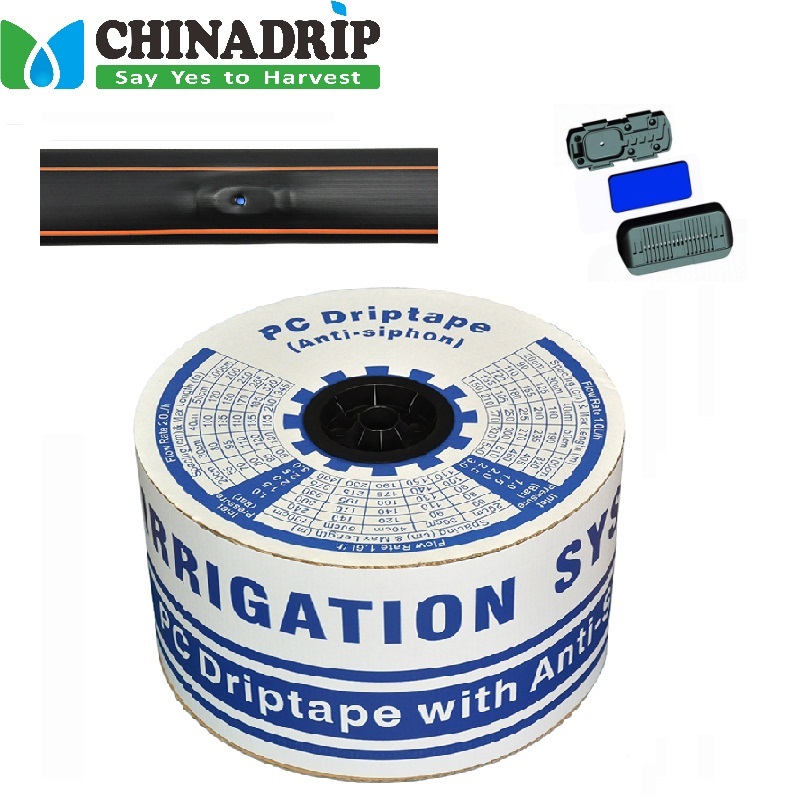
PC100 pressure-compensating drip tape with anti-siphon
Choose Between Pressure-Compensating and Conventional Emitters
Emitter design directly affects irrigation uniformity. Pressure-compensating (PC) emitters are designed to regulate discharge within a specified pressure range, while conventional non-pressure-compensating emitters generally show greater flow variation when operating pressure changes.
For relatively flat agricultural fields with stable pressure conditions, conventional drip irrigation products may be sufficient. However, projects involving long irrigation rows, sloping terrain, or varying elevation may benefit from pressure-compensating products.
Another important distinction is the anti-drain or no-drain function. In pulse irrigation systems, particularly in greenhouses and nurseries, anti-drain emitters can help reduce uneven discharge caused by differences in drainage time when irrigation stops.
Chinadrip lists common and anti-drain versions of its compact online PC drippers. The published specifications include the following:
| Parameter | Common PC Type | Anti-Drain Type |
|---|---|---|
| PC operating range | 0.5–4.0 bar | 0.7–4.0 bar |
| Closing pressure | Not specified | 0.15 bar |
| Opening pressure | Not specified | 0.35 bar |
| Available flow rates | 2, 4 and 8 L/h | |
| Recommended filtration | 130 microns / 120 mesh | |
Note: These are published specifications for the compact online PC dripper listed on the Chinadrip website, not universal specifications for all PC drippers.
The Compact Online PC Dripper with Self-cleaning uses labyrinth passages and a self-flushing design to improve clogging resistance. Its product information also describes applications in uneven terrain, greenhouses, nurseries, and landscape irrigation.
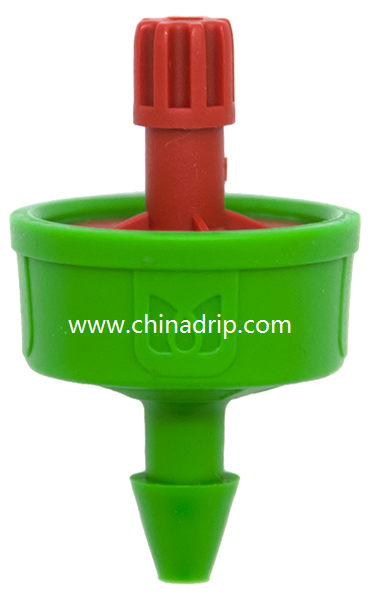
Compact online pressure-compensating dripper
Evaluate Filtration and Component Compatibility
Filtration is a critical part of drip irrigation system design because small emitter passages can become blocked by suspended particles, mineral deposits, or biological contaminants. Even a well-designed dripline may experience uneven water distribution if the filtration system is not properly matched to the water source and emitter requirements.
Before selecting a filter, buyers should consider:
- Water source and the type of suspended contaminants.
- Required filtration grade and compatibility with the emitter manufacturer's recommendations.
- Total system flow rate and operating pressure.
- Pressure loss across the filter during normal operation.
- Backwashing requirements and maintenance arrangements.
For larger irrigation networks, automatic self-cleaning filtration systems may be more suitable than relying entirely on manual cleaning. Their backwashing mechanisms can help remove accumulated contaminants and reduce routine maintenance work.
For example, Chinadrip's T2 automatic self-clean filtration system combines disc filters, hydraulic backwash valves, and a controller. Its published flow-rate range is 40–180 m³/h, making it important for buyers to check whether the actual system flow demand falls within the specified range.
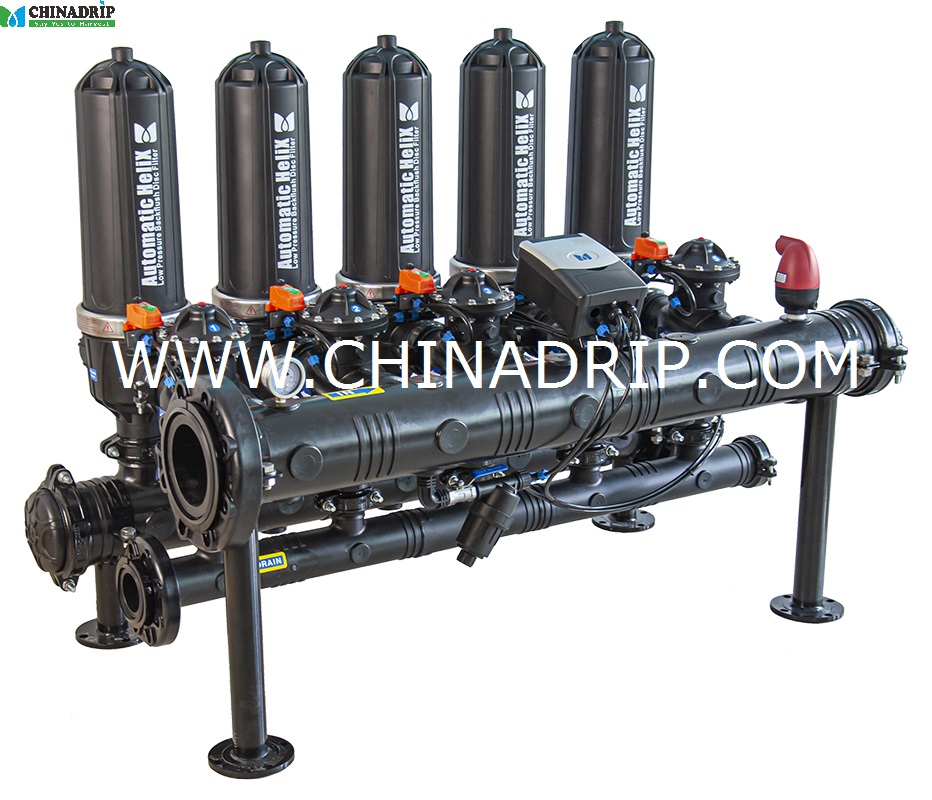
Automatic self-cleaning disc filtration system
Buyers can explore the T2 Type Automatic Self-Clean Filter System when evaluating filtration solutions for irrigation networks. The appropriate configuration should still be determined according to actual water quality, flow demand, and installation conditions.
Filtration and emitter specifications should therefore be reviewed together during OEM product selection. Choosing components independently without checking their technical compatibility can increase maintenance requirements and affect irrigation performance.
Check Manufacturing Quality Control Before Bulk Production
A reliable OEM drip irrigation manufacturer should have clear procedures for controlling product consistency throughout production. Buyers should not evaluate quality based only on appearance or a single approved sample.
For plastic irrigation components, quality checks may include dimensional inspection, material consistency, connection compatibility, pressure testing where applicable, and flow-rate verification. For drip tape and driplines, buyers should also pay attention to wall thickness consistency, emitter spacing, discharge uniformity, and leakage performance.
A practical quality-control process can be organized into three stages:
01. Incoming Material Inspection
Check raw material specifications, material consistency, and whether the supplied materials meet the agreed production requirements.
02. In-Process Inspection
Monitor critical production dimensions, molding quality, extrusion consistency, and other product-specific parameters.
03. Final Product Inspection
Verify finished product dimensions, appearance, functional performance, packaging, and compliance with the agreed specifications.
According to Chinadrip's published FAQ, its quality-control procedures include inspections after production processes, factory first inspection, random inspection, and final inspection based on customer requirements and applicable international standards.
When discussing an OEM order, buyers should also request information about inspection methods, acceptance criteria, sample approval, and how production deviations are handled. These details are particularly important for repeat orders, where maintaining consistency between batches matters as much as the initial product quality.
Confirm Customization, Samples, and Production Requirements
OEM customization should begin with a clear technical discussion rather than an immediate bulk order. Buyers should provide drawings, reference samples, product specifications, or detailed descriptions of the intended application.
Chinadrip's official FAQ confirms that customized products can be developed and manufactured according to drawings or samples provided by customers. However, the feasibility, tooling requirements, production schedule, and commercial terms should be confirmed individually for each project.
Before approving production, buyers should confirm the following:
- Technical drawings: Confirm dimensions, tolerances, connection interfaces, and product structure.
- Reference samples: Compare samples with the intended application and installation requirements.
- Material requirements: Specify the required material properties and environmental conditions.
- Packaging: Discuss labeling, packaging dimensions, and any private-label requirements.
- Order quantity: Confirm MOQ, production arrangements, and repeat-order conditions.
- Lead time: Agree on sample approval, production, inspection, and shipment schedules.
A signed specification sheet or approved reference sample provides a practical basis for checking whether the finished products match the buyer's requirements. It also reduces misunderstandings between the purchasing team and manufacturer during repeat orders.
Don't Overlook Drip Tape Fittings and Connection Compatibility
Drip irrigation performance depends on more than the main irrigation line. Connectors, offtakes, valves, and pipe fittings must also match the selected tubing dimensions and installation method.
For OEM buyers, connection compatibility is particularly important when sourcing products from multiple suppliers. A fitting that looks similar to another product may still have different dimensions, thread specifications, or sealing characteristics.
For example, Chinadrip lists a PVC offtake for drip tape with grommet, Dn17*15. Its product information specifies compatibility with drip tape thicknesses from 0.15 mm to 0.6 mm. This is a product-specific reference rather than a universal fitting standard.
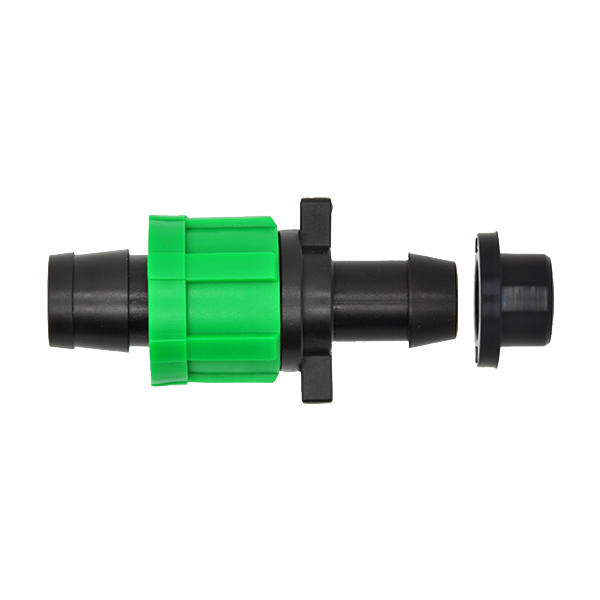
Drip tape offtake connector
Buyers can review the PVC Offtake for Drip Tape with Grommet, Dn17*15 when evaluating connection options.
Before bulk purchasing, it is advisable to test the fittings with the actual drip tape or pipe. Check the connection tightness, sealing performance, installation convenience, and resistance to leakage under the intended operating conditions.
How to Compare OEM Drip Irrigation Manufacturers
The right OEM partner should be evaluated through technical capability, product consistency, customization support, and communication efficiency. A low quotation alone does not necessarily indicate a suitable supplier for long-term cooperation.
The following comparison framework can help purchasing teams organize supplier evaluations:
| Evaluation Area | What Buyers Should Verify |
|---|---|
| Product Range | Availability of drip tape, drippers, filters, valves, and compatible fittings. |
| Technical Support | Ability to understand drawings, samples, and application-specific requirements. |
| Manufacturing | Relevant production equipment, processes, and manufacturing arrangements. |
| Quality Control | Inspection procedures, product testing, and batch consistency. |
| Customization | Feasibility of requested modifications, samples, and packaging requirements. |
| Commercial Terms | MOQ, quotation validity, lead time, payment terms, and shipping arrangements. |
| Communication | Response time, technical clarification, and after-sales support. |
For buyers considering Chinadrip, the company's published FAQ identifies it as a manufacturer with its own international trade department. It also provides information about customized production, manufacturing equipment, and inspection procedures. Buyers should use these published details as a starting point and confirm project-specific requirements directly with the company.
Frequently Asked Questions About OEM Drip Irrigation Manufacturing
1. What information should buyers provide when requesting an OEM drip irrigation quotation?
Buyers should provide product drawings or samples, material requirements, diameter, wall thickness, emitter spacing, flow rate, working pressure, order quantity, and packaging requirements. More detailed specifications help manufacturers evaluate feasibility and prepare accurate quotations.
2. Can drip irrigation products be customized according to customer drawings or samples?
Yes. Chinadrip's official FAQ confirms that it can develop and produce customized products according to drawings or samples provided by customers. Specific customization details, tooling requirements, and production arrangements should be confirmed before ordering.
3. What is the difference between pressure-compensating and conventional drip emitters?
Pressure-compensating emitters regulate water discharge within a specified operating pressure range, helping improve irrigation uniformity where pressure varies. Conventional emitters generally have greater discharge variation as pressure changes. The appropriate choice depends on field conditions, system design, and operating requirements.
4. Why is filtration important in drip irrigation manufacturing and system selection?
Filtration helps prevent suspended particles from entering small emitter passages and causing blockages. Buyers should match the filtration grade to the emitter manufacturer's recommendations and consider water quality, system flow rate, and maintenance requirements.
5. What quality-control checks should buyers request before bulk production?
Important checks include raw material inspection, dimensional measurements, wall thickness consistency, emitter flow testing, pressure testing where applicable, leakage inspection, and final product inspection. The exact acceptance criteria should be agreed upon before production.
6. How can buyers evaluate whether an OEM drip irrigation manufacturer is suitable for long-term cooperation?
Evaluate the manufacturer's product range, technical support, customization capability, manufacturing processes, quality-control procedures, sample consistency, MOQ, and delivery arrangements. Reviewing samples and confirming specifications before bulk orders can reduce sourcing risks.
Final Considerations for OEM Drip Irrigation Buyers
Successful OEM drip irrigation sourcing starts with technical clarity. Buyers should identify the intended application, establish measurable product specifications, check compatibility between emitters and filtration systems, and evaluate the manufacturer's quality-control procedures before approving bulk production.
For distributors and agricultural irrigation brands, working with a manufacturer that offers relevant irrigation components and customization support can simplify product sourcing and improve coordination across different parts of an irrigation system.
Chinadrip provides drip irrigation products, pressure-compensating drippers, filtration systems, valves, tubing, and related fittings. Buyers interested in OEM cooperation can explore the product range and contact the company to discuss drawings, samples, technical specifications, and project requirements.
Contact Chinadrip for OEM Drip Irrigation Solutions
Website: www.chinadrip.com
Email: sale9@chinadrip.com
Location: Xiamen, China