When planning a drip irrigation system, choosing between drip tape and dripline can affect installation costs, water distribution, maintenance requirements, and the overall performance of the irrigation project. Although the two products are often discussed together, they may differ in wall thickness, emitter design, pressure requirements, and intended service conditions.
For agricultural growers, irrigation distributors, and project contractors, the right choice depends on more than the product name. Crop type, field size, soil conditions, water quality, operating pressure, and expected service life should all be considered before placing an order. This guide explains the practical differences between drip tape and dripline and introduces irrigation solutions available from Chinadrip, a manufacturer of drip irrigation equipment and related components.
What Is Drip Tape?
Drip tape is a thin-walled irrigation tube designed to deliver water slowly and directly to crop roots. It is commonly used in vegetable fields, row crops, greenhouses, and other agricultural applications where irrigation lines are installed along planting rows.
Most drip tapes have built-in emitters or flow channels positioned at regular intervals. When water enters the tape, it passes through these channels and exits through small outlets. This arrangement helps distribute water along the crop rows while reducing unnecessary wetting between plants.
Drip tape is often selected for seasonal agricultural projects because its lightweight construction makes transportation, installation, and removal relatively convenient. Wall thickness, emitter spacing, and flow rate are important specifications when matching drip tape to a particular crop and field layout.
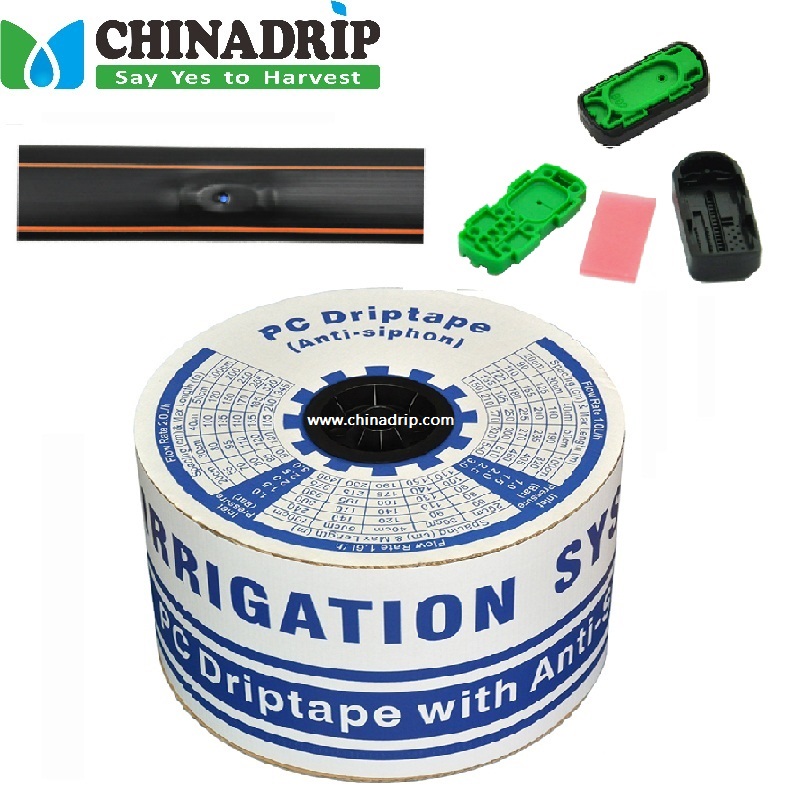
Chinadrip PC pressure compensating drip tape with anti-siphon design.
What Is Dripline?
Dripline is a drip irrigation tube that delivers water through integrated or installed emitters at defined intervals. Depending on the product design, dripline can have a thicker or more structured tube wall and may be intended for longer-term installation or more demanding irrigation conditions.
Some dripline products use pressure-compensating emitters to maintain a more consistent discharge rate when operating pressure changes within the specified range. This feature can be useful in fields with slopes, uneven terrain, or relatively long irrigation runs where water distribution needs to remain uniform.
Dripline is used in orchards, vineyards, greenhouses, landscape irrigation, and agricultural projects that require a stable and carefully designed water delivery system. However, the actual performance depends on the emitter type, tube dimensions, working pressure, filtration, and installation design.
For example, Chinadrip offers the PC100 Pressure Compensating 20mm Dripline with Anti-Siphon. Its product design combines pressure compensation with an anti-siphon function, making it a solution worth considering for projects that require consistent water delivery and subsurface drip irrigation compatibility.
Drip Tape vs Dripline: Key Differences
The main difference between drip tape and dripline is generally related to construction, emitter design, durability requirements, and application. However, product terminology is not completely standardized across the irrigation industry. Some manufacturers use the terms interchangeably, while others distinguish them according to wall thickness, material structure, and product performance.
The following comparison provides a practical starting point for buyers. Actual specifications should always be checked against the manufacturer's product data sheet.
| Comparison | Drip Tape | Dripline |
|---|---|---|
| Tube construction | Often thin-walled and flexible | May use a thicker or more structured tube wall |
| Emitter design | Integrated flow channels or emitters | Integrated or installed emitters, including PC options |
| Typical applications | Vegetables, row crops, seasonal planting | Orchards, vineyards, greenhouses, and longer-term systems |
| Installation | Lightweight and easy to handle | Depends on tube construction and system design |
| Service life | Depends on wall thickness, material, and use conditions | Depends on material quality, pressure, UV exposure, and maintenance |
| Cost considerations | Often suitable for cost-sensitive seasonal projects | Initial cost varies with specifications and emitter technology |
One important point for buyers: a product labeled as drip tape is not necessarily less capable than every product labeled as dripline. Pressure-compensating drip tape, for example, can offer advanced emitter performance. Always compare technical specifications rather than relying on product names alone.
Applications: When Should You Choose Drip Tape?
Drip tape is a practical option for agricultural projects where irrigation lines are arranged along relatively regular crop rows. Its flexible construction and convenient handling make it suitable for many seasonal planting systems.
Vegetable farming: Crops such as tomatoes, cucumbers, peppers, and leafy vegetables are commonly planted in rows. Drip tape can deliver water close to the root zone and support more controlled irrigation.
Open-field crop production: Large areas of row crops may benefit from lightweight drip irrigation lines that can be installed and managed efficiently during the growing season.
Greenhouse cultivation: Drip tape can be arranged along planting beds to provide localized irrigation. Emitter spacing and discharge rate should be selected according to crop spacing and water demand.
For projects that require different emitter spacing or discharge options, buyers can review Chinadrip's PC Drip Tape and Dripline product range to compare available configurations.
Applications: When Is Dripline a Better Choice?
Dripline may be more suitable when a project requires a specific emitter configuration, pressure compensation, or a tube construction designed for its operating environment. It is often considered for permanent or semi-permanent irrigation layouts, although the appropriate service life depends on the product specification and installation conditions.
Orchards and vineyards: Dripline can be installed along tree or vine rows to deliver water near the root zone. The required emitter spacing and flow rate depend on plant spacing, soil conditions, and irrigation scheduling.
Uneven or sloping fields: Pressure-compensating emitters can help maintain a more consistent discharge across the designed operating pressure range. This makes them useful for projects where elevation differences may affect water distribution.
Subsurface drip irrigation: Certain dripline products with anti-siphon features are designed for subsurface applications. The anti-siphon function helps reduce soil particle intrusion into the emitter when the system shuts down. Product suitability still depends on installation depth, soil type, filtration, and operating conditions.
Chinadrip's PC100 Pressure Compensating 16mm Dripline is one example of a product designed with pressure compensation and anti-siphon functions. The product information lists a working pressure range of 0.5–5 bar and a filtration requirement above 120 mesh. Buyers should confirm the applicable specifications for the exact model before system design.
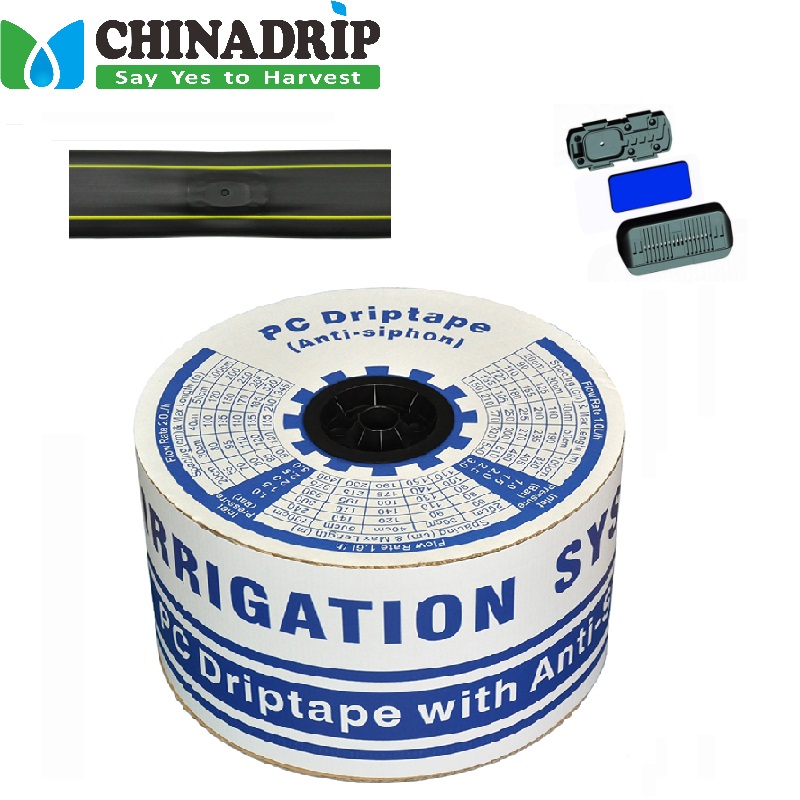
Emitter structure and drip tape product presentation.
How to Choose the Right Drip Irrigation Product
Selecting drip tape or dripline should begin with the irrigation project's actual requirements. A product that works well in one field may not deliver the same results in another environment. Before requesting a quotation, consider the following factors.
Crop type and planting layout: Identify the crop, row spacing, plant spacing, and root distribution. These details help determine the required emitter spacing and the number of irrigation lines.
Wall thickness and material: Wall thickness affects flexibility, handling, and resistance to physical damage. Buyers should compare the actual thickness and material specifications instead of assuming that all drip tapes or driplines have the same construction.
Emitter spacing and flow rate: Emitter spacing should match the distance between plants and the soil's water distribution characteristics. Flow rate, usually expressed in liters per hour (L/H), should be selected according to crop demand, soil infiltration, and irrigation duration.
Working pressure: Confirm the system's available inlet pressure and the product's recommended operating range. Pressure that is too low may affect discharge, while excessive pressure can damage components or cause leakage.
Terrain and irrigation line length: For sloping fields or long irrigation runs, consider whether pressure-compensating emitters are needed. Hydraulic calculations should also account for pipe diameter, friction loss, elevation changes, and the number of operating lines.
Water quality and filtration: Small emitter passages can become blocked by suspended particles, algae, or mineral deposits. A suitable filtration system is essential for maintaining stable irrigation performance. Depending on the water source and system design, buyers can explore Chinadrip's irrigation filtration products as part of the complete system.
Why Filtration and Fittings Matter
Choosing the right drip tape or dripline is only one part of a reliable irrigation system. Filtration, connectors, valves, and pressure control components also influence water distribution and maintenance requirements.
For example, a drip irrigation system supplied by a river, pond, or other surface water source may require filtration to remove suspended particles before water enters the emitters. The required filter type and mesh rating should be determined by the emitter specifications and the actual water quality.
Connections also need to match the selected tube diameter and system layout. Incorrect fittings can lead to leakage, pressure loss, and installation difficulties. Buyers planning a complete system can review Chinadrip's tubing and fitting range for compatible irrigation accessories.
A well-matched system combines the dripline or drip tape with appropriate filtration, pressure regulation, connectors, and control components. This system-level approach is generally more effective than selecting each component independently.
What Should Buyers Confirm Before Ordering in Bulk?
For distributors, agricultural suppliers, and irrigation contractors, bulk purchasing requires clear technical communication with the manufacturer. A detailed specification sheet helps reduce misunderstandings and makes it easier to compare quotations from different suppliers.
Before confirming an order, provide or request the following information:
- Product type: drip tape, dripline, or pressure-compensating dripline.
- Tube diameter and wall thickness.
- Emitter spacing and nominal flow rate.
- Working pressure and maximum recommended operating pressure.
- Material specifications and UV resistance requirements.
- Filtration requirements and water quality conditions.
- Roll length, packaging method, and order quantity.
- Required connectors, valves, and other accessories.
It is also advisable to request samples or technical documentation before placing a large order. Buyers should check dimensions, emitter spacing, flow performance, packaging, and compatibility with the existing irrigation system. For customized projects, drawings or samples can help the manufacturer understand the required configuration.
Drip Tape and Dripline Solutions from Chinadrip
Chinadrip Irrigation Equipment (Xiamen) Co., Ltd. manufactures and supplies irrigation products for agricultural irrigation systems, garden irrigation, and micro-irrigation applications. Its product range includes PC drip tape and dripline, PC drippers, PE pipes, fittings, filters, valves, and other irrigation accessories.
For buyers comparing drip tape and dripline suppliers in China, Chinadrip provides different product configurations for irrigation projects with varying requirements. Its PC100 pressure-compensating drip tape and dripline products feature integrated PC emitters, labyrinth flow passages, and self-flushing designs. Selected models also include an anti-siphon function for applications such as subsurface drip irrigation.
Chinadrip also states that it can develop and manufacture customized products based on customer drawings or samples. This can be useful for distributors and project buyers who need specific product configurations or components compatible with an existing irrigation system.
If you are sourcing drip tape, pressure-compensating dripline, or related irrigation components, visit Chinadrip's product catalog to review available solutions. You can also contact the team with your required specifications, application details, and estimated order quantity to discuss a suitable product configuration.
Frequently Asked Questions About Drip Tape vs Dripline
What is the main difference between drip tape and dripline?
Drip tape is commonly associated with lightweight, flexible irrigation tubing used in row crops and seasonal farming. Dripline may refer to tubing with different wall constructions or emitter designs, including pressure-compensating models. Since manufacturers sometimes use the terms interchangeably, buyers should compare the actual specifications rather than the product name alone.
Is drip tape cheaper than dripline?
Drip tape is often a cost-effective option for seasonal crop irrigation because of its lightweight construction. However, the final price depends on wall thickness, diameter, emitter spacing, flow rate, material, and order quantity. A direct quotation based on matching specifications is the best way to compare costs.
Can drip tape be used for subsurface irrigation?
Some drip tape products are designed for subsurface drip irrigation, particularly models with suitable anti-siphon features. Buyers should confirm the manufacturer's application guidance, installation depth, filtration requirements, and compatibility with local soil conditions before use.
Is pressure-compensating dripline better for sloping fields?
Pressure-compensating dripline can help maintain a more consistent emitter discharge within its specified operating pressure range. It is often worth considering for sloping fields and long irrigation runs, but the system still needs proper hydraulic design and pressure control.
How do I choose the correct emitter spacing?
Emitter spacing should be selected according to crop spacing, soil texture, root distribution, and the required wetting pattern. Closely spaced emitters may be suitable for some closely planted crops, while wider spacing may work for other planting layouts. Consult an irrigation designer or supplier when planning a large system.
What filtration is required for drip tape and dripline?
The required filtration level depends on the emitter passage design and water quality. Buyers should follow the product manufacturer's recommended mesh rating and select a suitable filter based on the water source and expected particle load.
Can Chinadrip provide customized drip irrigation products?
Yes. Chinadrip states that it can develop and manufacture customized products according to customer drawings or samples. Buyers can provide product dimensions, emitter specifications, application requirements, and target quantities for evaluation.
Choosing between drip tape and dripline is ultimately a matter of matching product construction and emitter performance to the irrigation project's needs. By comparing specifications, understanding field conditions, and selecting compatible filtration and fittings, buyers can build a more reliable drip irrigation system. Contact Chinadrip to discuss your project requirements and explore suitable drip irrigation products.